Wednesday, February 29, 2012

What is Mobility?


Nearly 50% of all workers in the United States are mobile and require the right combination of technologies and services to safely and effectively communicate—whether they are at home or on the road. An integrated mobility solution consists of software (security and management), hardware devices (smartphones, tablets, and notebooks), and cellular wireless activation services.

Many employees already have hand-held devices like phones or tablets for personal use; some of these devices can be repurposed for organizational use as well. Organizations may experience challenges with the bring-your-own-devices (BYOD) method: which devices, what carrier, and who will support the solution. What is the organization’s policy and does it include standardization of operating systems, handheld devices, and streamlined operations for a wireless broadband environment?
Providing seamless connectivity can include Wi-Fi in the local network and cellular wireless for remote access. The right mobility solution increases productivity end-to-end, reduces costs associated with management and OPEX and CAPEX expenditures, and provides a flexible work environment to increase customer and employee satisfaction.

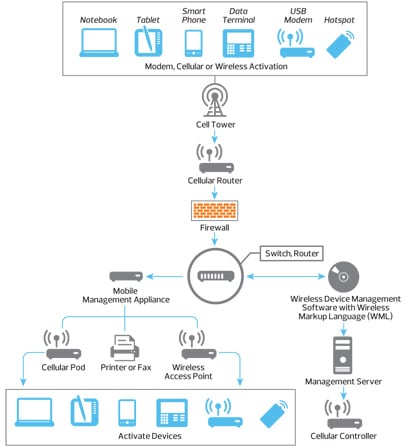
What Does a Mobility Solution Look Like?

  • Review a sample of a mobility solution.
  

What is Mobile Device Management?

Mobile Device Management (MDM) is a software application that needs serious consideration for any organization exploring a mobility solution. The software includes policy and security management capabilities across many different operating systems or platforms such as Apple, Android, RIM (BlackBerry), Symbian, and Windows. These applications typically are modeled after the client server architecture where software is centralized on a backend server and a client component resides on the end system device.
An MDM solution should offer the following standard functionalities:
  • Application Management—Deploy, update, and wipe
  • Policy—Develop and control the operational aspects of the mobile network
  • Inventory—Licenses, version control, provision, and support
  • Security Management—Enforce password settings, encryption, and remote lock and wipe

How Will Mobility Benefit My Organization?

A mobility solution keeps your organization running smoothly with cutting-edge technology, including:
  • Smartphones
  • Notebooks
  • Tablets
  • Routers
  • Data collection terminals
  • Wireless cards and adapters
  • Hotspots
  • Security Suites

How Can I Help My Organization Embrace Mobility Solutions?

When considering a mobility solution, it’s important to consider the following questions:
  • How quickly can you react to and identify a violation of your mobile policy?
  • What are you doing to manage and procure devices to optimize your wireless spend?
  • What mobile IT resources are required for employees to remain effective and efficient?
  • What is the total cost to your organization for provisioning and maintaining IT resources?
  • Are you dealing with multiple OSs and form factors?
  • How are personal liable devices currently secured?
  • Is there a need to activate new lines of service for smartphones or embedded notebooks?

What Comprises a Mobility Solution?

Our national providers can connect you to your resources with activation and additional services. We help you turn over the operational aspects to someone you can trust to have the right amount of expertise and experienced personnel to pull it off.
Our portfolio includes:

Dedication

Dedicated sales contacts and mobile wireless solution architects with the latest partner and industry trainings and certifications.

Software Services

Installation and configuration of software on wireless devices. Activate systems online prior to shipment with “turnkey” on-demand activation services:
  • Order Management
    • Procurement Web portal representation (AT&T, Sprint/Nextel, T-Mobile, and Verizon) for non-standard orders
    • Process and procurement Web site established for non-standard orders
    • Order processing via carrier portals or applications
    • Configuration services and user administration for BlackBerry, iPhone, and Android devices
  • Custom Kitting—software install, etching, and asset tags
  • Deployments—remote deployment help desk support
  • Device Pool Management—replacement devices
  • Device Recycling—wiping and disposal

Inventory Management

Expense and inventory management tracked and optimized to free up your personnel resources.

Carrier Management Services

Services to help with high-volume deployments across carriers and service lines.

Customized Support

On-site and remote installation, training, and support options for software and end user devices customized for your needs.

Getting Started with Mobility

Your CDW Account Manager and solutions architects are ready to assist you with every phase of choosing and leveraging the right solution for your IT environment. Our approach includes:
  • An initial discovery session to understand your goals, requirements, and budget
  • An assessment review of your existing environment and definition of project requirements
  • Detailed vendor evaluations, recommendations, future design, and proof of concept
  • Procurement, configuration, and deployment of the final solution
  • Ongoing project measurements to meet SLAs
  • Complete product lifecycle support
  • Consolidated device and solution management platform

Facebook redesigns business pages, adds Timeline


Starting today, companies can update to new Timeline feature on their Brand pages

Companies and organizations that have Brand pages on Facebook are not only getting a new look and new features, they're also going to be able to update their pages to use Facebook's new Timeline.
Facebook is planning an announcement about the Brand pages redesign at 1 p.m. ET today. However, the social network touted the news on The Today Show this morning, with the show revealing its own "facelift" of its Facebook Brand page.
[ Stay ahead of the key tech business news with InfoWorld's Today's Headlines: First Look newsletter. ]
Other companies launching a Timeline on their Brand pages include the New York Times, Starbucks, American Idol, the NBA, and the band Coldplay.
Facebook also has launched a page that gives users information about the redesigned Brand pages.
According to Facebook, any company or organization can update its Brand pages with Timelines now and they will all automatically be updated on March 30.
Facebook first widely pushed out its new Timeline feature in December. The feature is designed to automatically organize users' status updates, relationship changes, videos and photos into an interactive timeline of their online life. With Brand pages, followers will be able to see a history of the company's products and advancements, along with a history of posts.
The social network announced this morning that the revamped Brand pages also will include some other new features, such as the ability to "pin" posts that will effectively keep important news at the top of the Timeline for up to a week.
And an updated admin panel is set up to make it easier for page administrators to track a page's performance and respond to private messages from followers.
Companies also will be able to post larger photos and highlight milestones.

Google privacy checklist: What to do before Google's privacy policy changes on March 1


If you use any Google service, you’re about to surrender a lot more personal information to the Googleplex unless you take these steps to prevent it

We've been talking about it for weeks, but the big day is almost here: On March 1, Google will implement its new privacy policy and terms of service, unifying 70 separate privacy policies and extending them across most of Google's offerings.
This grand consolidation means that all of your Google account data will live in a single database that every Google service can access. Google Maps will have access to your Gmail data, which will have access to your YouTube history, and so on. Google insists that this change will ultimately benefit users, but privacy advocacy groups such as the Electronic Frontier Foundation fear that users will lose control over the personal data they've shared with Google.
[ The Web browser is your portal to the world -- as well as the conduit that lets in many security threats. InfoWorld's expert contributors show you how to secure your Web browsers in this "Web Browser Security Deep Dive" PDF guide. ]
If you'd like to exert control over your Google-based data, you still have time to act before March 1. Google's privacy settings can be tricky to navigate -- the privacy Dashboard doesn't provide full access to all privacy settings, and Google's Data Liberation tool doesn't support everything yet. But these tips should help limit what Google can find out about you.
Check the Dashboard
Your first destination is Google Dashboard. It provides an overview of the information Google has stored on your account across many of its most popular services. To get started, go togoogle.com/dashboard and log in with your Google account (typically an email address). There, you can see much of the data that Google has on you, from your Google+ account to your Gmail account.
Take a few minutes to click through the various services and to review the information Google is storing. Then clear out any data you no longer want associated with your account.
Clear your Google Web history
Google Web History keeps track of your Web browsing in order to help Google serve up more relevant search results, According to the company, Google Web History "saves information about your Web activity, including pages you visit and searches on Google. Over time, the service may use additional information about your activity on Google or other information you provide us in order to deliver a better search experience."
Even while you’re logged out of your Google account, Google achieve a similar effect by tracking your search history via a browser cookie.
To turn this off, visit google.com/history while signed into your Google account and click Remove all Web history. In the next screen, click OK to confirm your decision, and thenceforth Google will no longer track your Web history for the sake of improving search accuracy. As the EFF notes, however, Google may still log this information for various internal purposes.
If you don't have a Google account, or if you're logged out of your account, visitgoogle.com/history/optout and click Disable customizations based on search activity.
Tweak your ads preferences
By default, Google serves up "personalized" ads, based on search queries or on the content of your Gmail messages. For example, if you run a search for "Mobile World Congress," Google may serve up an ad for a phone or a tablet. If you find that kind of activity too invasive (or just plain creepy), you can dig into Google's privacy settings to disable personalized ads.
Head on over to Google's Ad Preferences page;  in the left-hand column, under "Ads on Search and Gmail," click Opt out. From there, click the Opt out button to the right, and Google will stop serving up personalized ads based on your search results.
You can also opt out of personalized ads that appear on other sites through Google's Web ad services. In the left-hand column of the same Ad Preferences page, under "Ads on the Web," clickOpt out, and then click the blue Opt out button to the right.
Liberate your data
If you want to remove some (but not all) of your personal data from multiple Google services, head over to Google Takeout, which lets you download a copy of your data from Google Buzz, Circles, Docs, Picasa Web Albums, Gmail contacts, and other tools and services. Get started by logging in to the Google Takeout page. Once there, you can download your data for all supported services, or you can pick and choose the data you want to download. Once you've chosen what you want to download, click the Create Archive button at the bottom of the page. Google Takeout will create an archive consisting of your downloadable data (it may take a few minutes for Google Takeout to create the archive for you).
After downloading the archive, you can delete the data from the individual Google services. Unfortunately, doing so is a manually operation--Google doesn't let you automatically delete the data you download from its servers. In addition, Google Takeout doesn't yet support all of Google’s services, so you won't be able to take everything with you. Still, some data removal is better than none.
The nuclear option: Delete your Google accountIf you feel truly paranoid, you can remove your Google account completely. Deleting your account will mean losing all of the information associated with it, including your Gmail account, your Google+ profile, and anything you've stored within Google Docs.
If you're willing to take the leap, log in to your Google account and visit your account settings page. Scroll to the bottom and, under Services, click Close entire account and delete all services and info associated with it. On the next page, Google will ask you to confirm that you really, truly want to delete your account. Follow the instructions, enter your password, take a deep breath, and click Delete Google Account.
On the other hand, you may want to delete just your Google+ account. If so, scroll to the bottom of the account setting page, and click Delete profile and remove associated Google+ features. From there, you can delete your Google+ content or your entire Google profile, which will remove you from Google+, Google Buzz, and several other services.
We're all for personal privacy, of course, but we also appreciate convenience. If you feel the same way, and you can deal with the reality that Google probably already knows a lot about you (and will soon know even more), you can leave your Google account as it is.
If you're on the fence, or just want to be fully informed about how Google collects and uses personal data, we recommend that you take one more step: Read Google's overview of its new privacy policy, or take the plunge and read the revised policies for yourself.

Thursday, February 23, 2012

Tough times for HP ahead; will investors wait?

Packard plans to spend years turning itself around as it addresses internal problems and battles broader threats from smartphones and tablet computers.


Investors willing to wait could be rewarded. Its market value is half of what it was about a year ago, and HP could start to improve in the second half of 2012.
It won't be easy, though.
After all, HP will need to fix itself as the personal-computing industry faces its own challenges, including reduced spending by consumers who are saving up for iPads and other popular devices.
Richard Gardner, an analyst at Citi Investment Research, described HP's road to recovery as "not a journey for the faint of heart."
After presiding over her first full quarter as CEO, Meg Whitman said Wednesday that she has a good sense of what the company needs to do.
For starters, Whitman said, HP needs to fix its internal operations. The company is unable to turn orders into products quickly enough, and its supply chain is a mess. HP has numerous parts in its inventory, but not necessarily the right parts to fulfill actual orders. The variety also creates confusion in sales and technical support. Whitman said HP needs to invest more in internal systems and procedures.
Longer term, she said, the company needs to spend more money to grow businesses such as security services, information management and Internet-based systems known as cloud computing.
"We didn't make the investments we should have during the past few years to stay ahead of customer expectations and market trends," Whitman said. "As a result, we see eroding revenue and profits today."
HP reported a 44 percent drop in net income to $1.47 billion, or 73 cents a share, in the November-January period. Revenue was $30 billion, down 7 percent and slightly below forecasts of $30.7 billion. It was the fastest revenue decline for the company since the recession hit 2009 results.
The division that makes PC desktops and laptops saw revenue fall 15 percent to $10.4 million. That's still about a third of the company's revenue. A shortage in hard drives because of flooding in Thailand was partly to blame. So was increased competition from mobile devices, which HP quit making last year after losing to Apple and manufacturers using Google's Android system.
To pay for investments, HP needs to cut costs. Whitman didn't offer specifics; some analysts foresee "restructuring" — which often means job cuts.
"We have got to save to invest," she said. "We have got to save to grow."
Whitman became CEO in September after HP fired Leo Apotheker just 11 months into the job. Apotheker also complained about underinvestment by his predecessor, yet his decisions hadn't instilled any confidence.
Among other things, Apotheker announced that HP was looking to jettison its PC unit, which has large volume but small profits. That scared off some buyers, who may not have come back when Whitman decided to keep the division.
Whitman pleaded patience as she described "a multiyear journey."
Investors responded by selling shares of HP. The Palo Alto, California, company's stock fell $1.89, or 6.5 percent, to close Thursday at $27.05. Its market value of $54 billion compares with $104 billion about a year ago.
Louis R. Miscioscia, an analyst with Collins Stewart, said the stock looks cheap, but a turnaround now seems further away. He noted that IBM Corp., which transformed from a dying PC maker to a leading provider of software and services, had to work hard for more than a half decade to get there.
Nonetheless, he raised his price target on HP's stock Thursday to $28, from $25.
Of course, HP may be intentionally setting expectations low.
Analyst Shaw Wu at Sterne Agee said many investors dismissed Cisco Systems Inc. a year ago, after its focus got scattered from expanding into too many new markets. But the network-equipment maker has reported a few good quarters in a row. The stock is up nearly 50 percent since Aug. 10.
Wu expects HP's revenue decline to start slowing by midyear. That's when supplies of hard drives should rebound. Soon after that, HP could see increased sales from an upcoming release of Microsoft's Windows 8, an operating system that would work similarly on PCs and tablet computers.
If that's the case, a turnaround may happen sooner and reward investors who buy HP's stock now and hang on to it.
"It's tough to count them out," he said. "They have a lot of the ingredients. It boils down to execution. At least they have a game plan in place."

Apple ponders cash, caves on board-vote proposal


Apple CEO Tim Cook speaks at Apple headquarters in Cupertino, California October 4, 2011. REUTERS/Robert Galbraith
Apple CEO Tim Cook speaks at Apple headquarters in Cupertino, California October 4, 2011.
Credit: Reuters/Robert Galbraith
CUPERTINO, California | Thu Feb 23, 2012 10:35pm GMT
(Reuters) - Apple Inc on Thursday adopted a measure long desired by investors and corporate governance activists, granting its shareholders a bigger say in the appointment of directors to the board of the world's most valuable technology company.
Chief Executive Tim Cook also repeated that he has been "thinking very deeply" about investors' demands that the consumer electronics company return some of its $98 billion in cash and securities to shareholders via a dividend.

T-Mobile's comeback plan: Is it enough?


T-Mobile plans to invest $4 billion to upgrade its network and roll out 4G LTE, and its CEO will focus on improving the brand and customer satisfaction. But deep challenges remain.
T-Mobile USA's revamped retail stores, part of its bid to turn itself around last year.
(Credit: T-Mobile USA)
T-Mobile USA faces a daunting uphill climb as it looks to turn itself around.
The nation's fourth-largest wireless provider, two months removed from a failed attempt to merge with AT&T, today laid out its comeback plan, which includes improving its existing network and deploying 4G LTE by 2013. Parent Deutsche Telekom has committed to investing $4 billion in the business, and signaled a willingness to explore other options, which could include an initial public offering or the sale of assets.
That T-Mobile is investing in its network and getting serious again about winning back customers is positive for a business that remained stagnant last year amid a looming takeover. But its challenges are legion. The carrier's fourth-quarter results saw the carrier take another step back, which CEO Philipp Humm blamed on the introduction of the iPhone 4S. Some also question the company's ability to remain competitive given its relatively weak spectrum position and investment.
"Even with the new LTE strategy, there are significant challenges ahead," said Jan Dawson, an analyst at research firm Ovum. "T-Mobile will be late to the LTE party, and its coverage will lag its major competitors for some time."
T-Mobile is once again embracing its upstart challenger role in the industry because it has little other choice. More than at any point in its history, T-Mobile is on the outside looking in. It's the only national carrier still seeing massive subscriber losses, and is the only one that still lacks the iPhone. Humm said that with the cloud of AT&T cleared away, the company can go back to aggressively going after consumers through price and the strength of its offering.
"The AT&T deal obviously had a negative impact," Humm said in an interview. "It's a good chance to reinvigorate our brand."
Bringing T-Mobile back 
Humm blamed the uncertainty caused by the AT&T deal for T-Mobile's deteriorating brand, a lower customer service rating, and lost customers. The company also halted projects while the merger was being evaluated that are now in the process of getting spun up again.
Yet T-Mobile needs to send a thank you note to AT&T for its renewed aggressive posture. The carrier extracted a generous breakup fee--which included $3 billion in cash and a roaming agreement worth another $1 billion--from AT&T after their deal collapsed.
The cash infusion has helped convince parent Deutsche Telekom--which previously expressed reluctance at investing in the U.S. business--to pour money into network improvements that are critical for keeping T-Mobile competitive even as larger rivals Verizon Wireless and AT&T race to roll out their own 4G LTE network.
The network improvements include using more modern equipment in its network infrastructure, moving its spectrum more in line with the two major carriers and carriers around the world. Chief Technology Officer Neville Ray said the switch to different spectrum would make its network compatible with more devices, including the iPhone.
The improvements will include placing LTE Advanced hardware in its network during the deployment, allowing it to make an easy transition to the next evolution of 4G LTE when more devices are available, Ray said.
T-Mobile plans to use existing spectrum already dedicated to its 2G and 3G networks and rededicate it to 4G LTE, a practice known as re-farming. The network will also be augmented by the roaming agreements from AT&T.
This year, Humm said he expects to reduce the turnover rate for its contract customers, while its prepaid customer base should continue to see good growth. He acknowledged that customer growth will continue to face challenges over the next two years, which he considers a rebuilding period. But the moves made now will pay off by 2014 and beyond, he said.
The company also hopes to improve its wholesale business by encouraging resellers to jump on its network. Humm said AT&T again had hurt its ability to sign new business last year, but he expects that will be a big contributor down the line. T-Mobile is looking to launch a platform to make it easier for resellers to jump on to its network, and also plans to offer more aggressive rates.
Big challenges 
Critics, however, say the $4 billion figure isn't enough to keep pace with Verizon and AT&T, which are pouring significantly more into their network deployment. While the other wireless carriers are planning to roll out their next-generation service throughout much of their territory, T-Mobile can't afford to be so widespread in its deployment.
T-Mobile plans to cover the top 50 markets with 4G LTE by the end of 2013. But in 25 of those markets, the carrier will only be able to offer a limited amount of spectrum. The company has few sources for an immediate infusion of badly needed spectrum, which is required to quickly ferry data and voice traffic over the air.
Another challenge will be in the confusion brought on by its own definition of 4G. Since 2010, T-Mobile renamed its HSPA+ network--widely considered a 3G technology--its 4G network. With the widespread availability of HSPA+, T-Mobile was able to boast of having the nation's largest 4G network.


Verizon reacted by campaigning around the 4G LTE moniker to differentiate itself. The flood of marketing has been somewhat effective in distinguishing 4G LTE as a higher-end service--even if many don't really understand--or care--that it stands for another technology called Long-Term Evolution.
Humm said he doesn't expect to jump on the 4G LTE brand even when T-Mobile moves to that technology. The company will likely stick to the 4G name for its service, and that devices will move back and forth between the networks without the customers' knowledge.
The issue for T-Mobile is that it will be woefully behind on its LTE deployment by the time it gets started. Verizon has worked at a relentless pace to get its network rolled out, while AT&T is steadily rolling out its own network. Sprint Nextel said its first few markets will launch by the first half of this year. They are all expected to have a majority of their rollout completed by 2013. At that point, LTE will just be another standard feature, as opposed to the premium selling point it is now.
T-Mobile's other major challenge continues to be the iPhone. The company lost a total of 802,000 customers in the final quarter of 2011, a huge drop from the 251,000 who jumped ship in the prior year's quarter. While Humm expects improvement, a return to growth on the contract side remains far from certain.
Humm declined to comment on any potential deal with Apple, but reiterated that he would like to get the iPhone under the right terms. He noted, however, that the other carriers all took a hit in their margins as a result of the cost of carrying the iPhone. For now, the company is planning to focus on offering a better lineup of Android and Windows Phone devices. For instance, it is currently pushing its budget-friendly Nokia Lumia 710 and the Samsung Blaze 4G.
While the iPhone does come at a considerable cost, the other carrier executives have all said that the subscriber growth that comes from the device makes it worth the near-term pain.

Wednesday, February 22, 2012

10 top inventions for 2011

  • In the five years that Popular Science has run the Invention Awards, we’ve seen a lot of remarkable things come out of people’s garages. Some are designed to treat the sick or save the planet. Others are simply fun to play with. But no matter what the purpose, the brilliance of the inventions and the dedication of the individuals behind them are always inspiring.
    This year’s 10 honorees carry on the tradition: a pen that can screen for prenatal diseases for less than a penny, a machine that uses a boat’s exhaust to treat onboard waste, and even a jet-propelled body board light enough to carry from your car to the water. Each of this year’s inventions takes on a different challenge—and solves it in its own ingenious way.
  • The Stark Hand
    Image: A prosthetic hand protoype is cheap, and helps the wearer catch balls and grip wine glasses.
    John B. Carnett  /  Popular Science
    Created by Mark Stark, The Stark Hand prototype provides an ingenious, comfortable, and very inexpensive alternative to the hook his friend Dave Vogt had worn all his life. With the new hand, Dave can now catch balls and grip wine glasses. You can read more about the Stark Hand, and watch the video of its throwing and catching abilities, here.
  • The BodyGuard
    Image: This crime-fighting armored glove has a wrist-mounted stunner and a video camera built in.
    John B. Carnett  /  Popular Science
    David Brown designed The BodyGuard, a crime-fighting armored glove, as built-in self protection. The demo model has a camera, a wrist mounted stunner and lots of room for future improvements. The idea came to David while talking to his friend, Kevin Costner. Check out our full feature, and awesome video, on the BodyGuard here.
  • The PrintBrush
    Image: This lightweight PaintBrush fits in a laptop bag and prints on any flat surface.
    Jonathan Worth  /  Popular Science
    Weighing in at less than a pound, Alex Breton's PrintBrush easily fits in a laptop bag and prints on any flat surface, from wood to fabric to plastic. Alex worked on the project for 11 years, but a version with a bonus built-in camera comes out early next year. Want to see this handheld printer in action? Check out our feature — and video — here.
  • The Katal Landing Pad
    Image: This giant cushion gives snowboarders a soft landing.
    Jussi Grznar  /  Popular Science
    Aaron Coret and his friend Stephen Slen came up with the Katal Landing Pad after Aaron had a nasty snowboarding accident. The board, which was used during the 2010 Winter Olympics, provides a giant cushioned landing for snowboarders and helps make the sport safer. Check out our feature on the Katal Landing Pad, with bonus video interview, here.
  • Dynamic Eye Sunglasses
    John B. Carnett  /  Popular Science
    Unlike regular sunglasses, Chris Mullin's glasses block glare instantly with liquid crystal lenses that darken the most where the sun's light is the brightest. A particularly sunny commute inspired Mullin's invention. Want to see these glasses in action? Check out our feature, and video, here.
  • The Bed Bug Detective
    John B. Carnett  /  Popular Science
    Built to imitate a dog's nose, the Bed Bug Detective sniffs out bedbugs quickly. Chris Goggin plans to create a model that can detect other pests, too, including mice and cockroaches.
    Read more about this bedbug detector here, and check out our video of the sniffer in action.
  • A Prenatal Marker to Screen for Pregnancy Complications
    John B. Carnett  /  Popular Science
    Designed by a college student and his classmates, the Prenatal Screening Kit, or safety pen, helps detect complications in pregnancies at an early stage. The pen will be quite cheap, costing only a third of a cent per use, making it a perfect tool for hospitals in developing nations. Click here for more info on this amazing medical advance.
  • The Zero Liquid Discharge
    Image: The Zero Liquid Discharge vaporizes sewage from boats, airplanes and RVs.
    John B. Carnett  /  Popular Science
    With a pleasant name for a gross procedure, the Zero Liquid Discharge, or ZLD, completely oxidizes and evaporates sewage from boats, airplanes and RVs. After flash evaporation, the waste leaves as a harmless, odorless aerosol. Click here to read more about the ZLD and see a video of its waste-fighting in action.
  • Kymera Motorized Body Board
    Image: The Kymera Body Board — a light, motorized body board.
    John B. Carnett  /  Popular Science
    The lightweight Kymera Body Board is Jason Woods's solution for a timeless problem (for lucky people): how to have fun at the lake without the hassle of lugging a boat around. The latest version of his motorized body board hits speeds of 25 mph. Want to see this part-boat, part-body-board in action? Check out more info (and a video) here.
  • The Medical Mirror
    Image: The Medical Mirror can tell you your heart when you look at it. A webcam behind the mirror captures variations in reflected light on your face, and an algorithm translates that into heartbeats.
    John B. Carnett  /  Popular Science
    While it can't tell you if you're the fairest of them all, the Medical Mirror can tell you your heart rate, which is probably more valuable in the long run anyway. A webcam behind the mirror captures variations in reflected light on your face, and an algorithm translates that into heartbeats. Read more about this futuristic mirror here — there's even a video of it in action.

Monday, February 20, 2012

What Will The Internet Look Like In 10 Years?

Future Scenarios


What Will The Internet Look Like In 10 Years?

The Internet Society engaged in a scenario planning exercise to reveal plausible courses of events that could impact the health of the Internet in the future. While obviously not intended to be a definitive overview of the landscape or all potential issues, we believe the results are interesting and, we hope, thought-provoking.
We are sharing them in the hope that they will inspire thought about possibilities for the future development of the Internet, and involvement in helping to make that happen in the best possible way.

Future Scenario Resources

Besides viewing the video scenarios below, you can:

Common Pool Scenario


 Positive “generative” and “distributed & decentralised” properties.

  • Opportunity and growth abound, with no insurmountable barriers to entry for those wishing to take part.
  • Disputes and challenges are resolved through competition, as opposed to negotiation or inherited rights.
  • Constant evolution and features a healthy ecosystem of interlinked network operators, developers, infrastructure providers, resource management organisations, etc.
  • Organisation and operation tends to be “horizontal”, not “vertical”, so that the underlying building blocks (technologies, networks, etc.) are available to all to build upon.
  • The “win” for the Internet is that it remains able to react and respond to new requirements.
  • Read more about the Common Pool Scenario

Boutique Networks Scenario


  • Envisions a future in which political, regional and large enterprise interests fail to maximise the social and economic potential of a shared, global set of richly connected networks (the Internet).
  • It carries the weight of self-interest brought by factions seeking to optimise control in small sectors (political and otherwise).
  • It also suggests these fractionalised networks will continue to leverage the benefits of existing Internet standards and technology.
  • Each proprietary provider draws as much as possible from the common pool while giving little back.
  • Read more about the Boutique Networks Scenario

Moats and Drawbridges Scenario


  • Suggests the world of the Internet would be heavily centralised, dominated by a few big players with their own rules in “big-boys’ clubs.”
  • Conflicts would be resolved through negotiation, not competition.
  • Connections between networks would be the result of extensive negotiation and deal making.
  • There would likely be strong regulation as governments seek to impose some public interest obligations and perhaps even controls on the equipment users can connect to the network.
  • Much content would be proprietary and protected by strong intellectual property rights.
  • Governments would control the behaviour of networks and network users through legal mechanisms and sanctions.
  • Barriers to entry would be high, with little incentive to expand networks beyond the largest and richest customers or regions.
  • Innovation would be slow, only occurring when it would benefit the network owners.
  • All players would have close political links to their mutual benefit.
  • Read more about the Moats and Drawbridges Scenario

Porous Garden Scenario


  • Sees networks staying global but with access to content and services tied to the use of specific networks and associated information appliances.
  • Individual (business) viability would triumph over the economic potential of the common pool of the Internet.
  • Financial incentives for content producers and software developers would mean continued innovation within the appliance-based model.
  • Control over content, pricing, licensing and other concerns would be firmly in the hands of relatively few large commercial organisations.
  • Proprietary, closed technologies would abound and exclusive deals with content producers and physical communications networks would oblige consumers to purchase multiple appliances and associated subscriptions to avail themselves of the full range of innovation on the network.

Popular Posts

Followers